Natural light
  • News and Blog

World Wetlands Day - poetry prize

8/1/2016

0 Comments

 
Picture
I shall be spending World Wetlands Day in one of the World's most famous wetlands - Doñana, in southern Spain.  It is a place I know well and love, and it will be good to get back.  I was last there in spring 2014, on two occasions. In the March Julian Rush and I went there to make a programme for BBC Radio 4's Costing the Earth.  A month later I was back with The Observer's Robin McKie.

It was part of an EU-wide effort to persuade governments of the vital value of wild places and the European legislation that protects them.  The EU Birds and Habitats Directives had been under attack for some time, with developers and some governments regarrding them as a barrier to economic progress.  The campaign demonstrated how false this idea was, and just before Christmas the UK government, which had previously been particularly negative towards the Directives, announced that it was not going to push for them to be weakened.

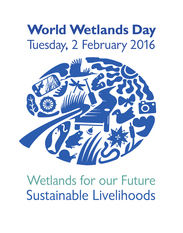
Another pillar of international protection is the Ramsar Convention, a global agreement focusing on wetlands.  Every year on 2 February, the anniversary of its adoption in 1971, the Convention secretariat organises World Wetlands Day.

Unfortunately, wetlands are often viewed as wasteland, and more than 64% of the world’s wetlands have disappeared since 1900.  Much of the remaining resource is suffering neglect and mismanagement.  Yet livelihoods from fishing, rice farming, tourism and water provision all depend on wetlands.  They host a huge variety of life, protect our coastlines, provide natural sponges against river flooding, and store carbon dioxide to regulate climate change.

Celebrating wetlands through poetry - deadline 24 January
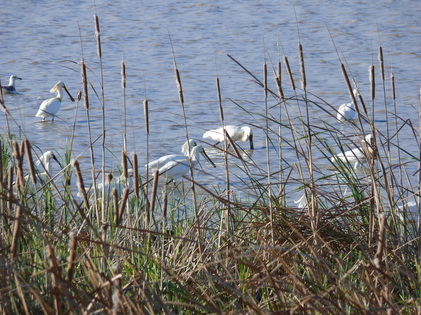
Eurasian spoonbills Doñana by Laurence RoseSpoonbills in Doñana ©Laurence Rose
Wetlands for our Future: Sustainable Livelihoods is the theme for World Wetlands Day in 2016. The aim is to demonstrate the vital role of wetlands for the future of humanity and specifically their relevance towards achieving the new Sustainable Development Goals.

An international poetry competition opens tomorrow, 10 January and closes on 24 January.  Entries will be judged by English-born Tasmanian poet Sarah Day whose most recent collection Tempo has been shortlisted for the Australian Prime Minister's Literary Awards.  There is a prize of AUS$700 and AUS$100 for shortlisted entries.

​Click the button for rules and other details. Note the deadline is midnight on 24th Melbourne time - 11 hours ahead of GMT.

Poetry prize

Doñana and The Long Spring

The reason for my visit to Doñana next month is to kick off a new project.  Between February and June 2016 I will be tracking the arrival of spring in Europe, from the Mediterranean to the Arctic.  Starting on the North African coast, and visiting some of the most interesting wild places in Spain, France, the UK, Sweden, Finland and Norway, I will report back on what I find on www.thelongspring.com.
​
I’ll be describing wildlife, places, traditions, culture and issues as I look for signs of the coming of spring. I will be finding out how spring is marked by people in the areas I visit, investigating people’s connection to their natural environment and seeing how this is changing.

I'll also use the blog to report on news from elsewhere, such as webcams from special places as the new season gets underway.  

The Long Spring is also the working title of my forthcoming book, provisionally scheduled for publication in early 2018, by Bloomsbury.
0 Comments

R.S. Thomas the birdwatcher

19/12/2015

0 Comments

 
This 1995 documentary was recently posted on YouTube.  It reminds us that the great Welsh poet R.S. Thomas (1913-2000) was a keen birdwatcher.  He admits to being more in tune with nature than with humans, and as the programme reveals, his postings as an Anglican vicar included the Dovey Estuary and the Lleyn peninsula, chosen for their ornithological importance.

"I looked for God on Mount Olympus, but all I saw was a crested tit" he said.
0 Comments

Chris Watson:  Okeanos

16/12/2015

0 Comments


​Review:  London Contemporary Music Festival 14 December

Picture

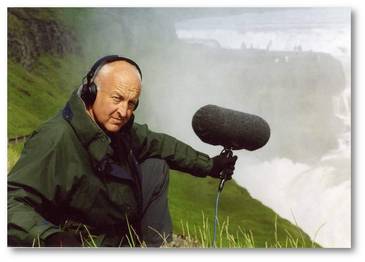
​In his short introduction to Okeanos, Chris Watson told a packed house, assembled in the cavern-like underground Gallery Ambika P3, at the University of Westminster, that the seas and oceans are the most sound-rich environment on the planet.  Six years of recording and assembling these sounds led to Okeanos, an eight-channel composition of songs, signals and vibrations  from the smallest crustaceans to the loudest and largest animals ever to have existed.

Watson may be best known as the recorder of wildlife sounds made famous in the Attenborough programmes or Tweet of the Day, but he first came to public attention in the seventies as a musician, part of the trio Cabaret Voltaire.

Okeanos is in essence an hour of underwater recordings made using hydrophones hung ten to twenty metres below the surface, at various places around the globe.  To rely entirely on natural sound to sustain a long piece is a compositional challenge.  Watson succeeds partly by exploiting the narrative logic of a journey from pole to pole, but mainly by careful recompilation of sound, from the large-scale and structural to the minute and detailed, to create a musical logic too.
​
Beginning at eighty degrees south, and above the surface, we hear a colony of Adelie penguins.  We follow them into the sea, and into a sound-world of singing Weddell seals and vast movements of water.  These undersea waves and swells have a sound unlike those at the surface or on the shore.  Having nothing to resound against but other bodies of water, they create a deeply menacing pulse.  Against this the singing seals and myriad small sounds provide an orchestra of microscopic detail.

PictureChris Watson
​The icy Antarctic waters merge into the Indian Ocean and coral reefs with thousands of tiny sounds from crustaceans and molluscs.  Across to the Caribbean and the virtuoso singing of humpback whales, before crossing to the Atlantic coast of western Scotland.  Here grey seal females provide a touching harem chorus.  Orcas off Norway’s Lofoten Islands join in with songs that sound like they were created digitally, unlike any that could be created for an airborne acoustic.  It is the sound-carrying qualities of sea water that are part of the attraction for Watson.  In the final leg of the journey, the sounds of bearded seals off Svalbard, were recorded up to twenty kilometres from their source, but are as clear and haunting as if they were with us in the gallery.
​
If being a composer is all about choosing, matching and compiling sonic elements, then Chris Watson is a composer.  Arguably he has a greater orchestral scale and diversity at his disposal than any other composer, as well as an unrivalled knowledge of both the technicalities of obtaining these rare sounds and their zoological importance.  This attention to context is the key to making a work that is both beautiful and authentic, not to mention a revelation. 

0 Comments

Lyrebird causes a rumpus

26/11/2015

0 Comments


Babies welcome at Spitalfields next week

PictureCopyright Spitalfields Music / James Berry
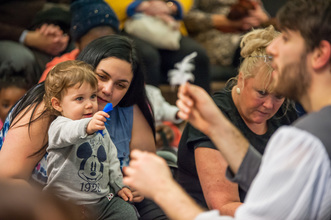
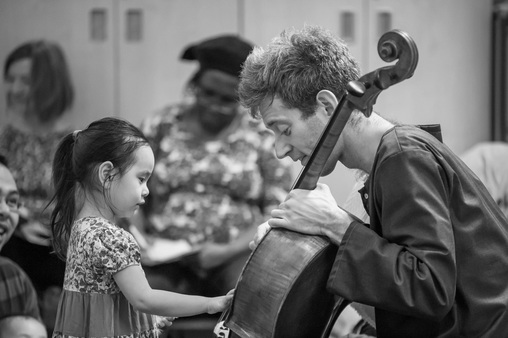
The extraordinary mimcry of Australia’s lyrebird has inspired artist Zoë Palmer to create an extraordinary opera, or, as she describes it, an interactive musical adventure made especially for 0-2½ year-olds.  Musical Rumpus:  Lyrebird has toured venues in the East End of London, culminating on 4 and 5 December in the final performances at Rich Mix, Bethnal Green Road, as part of the Spitalfields Festival.

I asked Zoë why she chose the lyrebird to provide very young children with their first music theatre experience. Like many of us, Zoë first discovered the lyrebird through David Attenborough’s Life of Birds.  “Ever since I saw that clip on YouTube I knew I wanted to work the lyrebird into one of my shows.  I was inspired by the incredible mimicry, this bird that could imitate anything from other species to camera shutters.

“It was also very moving, because this particular bird was imitating chainsaws, too, creating a record of the destruction of its own habitat.”

So how did this become the inspiration for Musical Rumpus?  “I’ve been specialising in early years music, but I’ve also recently completed a Masters in Human Ecology, and I realised the lyrebird is some kind of metaphor for creative development.
​
“It’s an abstract piece, but it is based around the idea of the bird doing what children do, borrowing material and creating their own language.  Eventually it comes together in a developing language of words and song.”

PictureCopyright Spitalfields Music / James Berry
She also sees a deeper, primeval connection.  “Before words and music were natural sounds, which blossomed into beautiful loops and patterns and sang the world into being.”

The 50-minute work casts the children as a “roving chorus”, gathering sounds from three different environments: home, city and forest, and creating their own song.  Parents are invited to engage, too.  Some, Zoë says, are a bit frightened, uncomfortable with letting go and simply being, but most get wrapped up in a shared experience with their babies.

Musical Rumpus: Catch a Sea Star @ Juice from Spitalfields Music on Vimeo.

Lyrebird is one of the award-winning Musical Rumpus series of interactive operas created by Zoë and her team, which includes Sam Glazer (music & musical director) and Sophia Lovell Smith (designer).

A Spitalfields Music production supported by Arts Council England, Dunard Fund, Esmeé Fairbairn Foundation and Paul Hamlyn Foundation

​
Tickets and details
And for a reminder of what the real lyrebird sounds like, here's one that lived in Adelaide Zoo, imitating kookaburras, whipbirds, and a pair of jobbing builders.
0 Comments

Call for forest art proposals

18/11/2015

0 Comments


Closing date: Monday 1 February 2016

Picture
Picture
​Jerwood Charitable Foundation and Forestry Commission England have announced the second edition of Jerwood Open Forest, an opportunity for visual artists to propose ideas for a major new £30,000 commission to be realised anywhere within England’s Public Forest Estate, supported by Arts Council England.
Jerwood Open Forest facilitates new interactions between artists and forests and opens up new art experiences to a wide public audience.  They are seeking bold, broad-thinking proposals that explore the potential of forests as sites for art, both in and about the environment. Proposals can be for work in any discipline or medium, temporary or permanent, site-specific or for touring to more than one location. From initial ideas submitted, five artists or collaborations will be selected to each receive a £2,000 research and development fee to develop their proposals over a six-month period. 

Click on the banner above for more details.
Picture
Cosmos by Semiconductor commissioned through the first edition of Jerwood Open Forest in 2014
0 Comments

Paris, Paris and Paris

17/11/2015

0 Comments


Three reasons to look toward La Ville Lumière

Picture
​We are all with Paris, trying to understand the incomprehensible.  And with or without Friday’s outrage, in two weeks’ time we would still all be with Paris, trying to unravel the tangle of politics, science and human rights that is the climate change agenda.  Next month world leaders assemble there for the most important climate change negotiations to date, and tens of thousands of activists and fossil fuel industry lobbyists will converge on the city, too.  At the forefront of representing civil society will be ArtCop21, a climate festival of culture and arts, with over 120 events, exhibitions and installations across the city.  It’s a global festival:  artists are participating on all continents with over 420 events in total.

Meanwhile, Paris and the other great cities of western Europe remain in the minds and the hopes of a tide of refugees, many of whom are there already, most are yet to set off on the most traumatic and possibly hopeless phase of their lives.

​The world leaders at the climate summit will trade rhetoric on these issues, and the original purpose of their conference may be pushed into second, or even third place behind discussing (the oil-rich) Islamic State and the human tide flowing across our borders.  They will want to compartmentalise their agenda, keep these issues separate in their talks, they are each complex enough on their own.
Expect a 100-year wave of climate refugees
PictureEXTREME WHETHER: A NEW AMERICAN CLIMATE DRAMA Paris 10-12 December
​​But there is a case for keeping it all ravelled together.  If carbon emissions targets were simply about striking a balance between conflicting economic pressures on western governments, there would be no need to assemble in one place to thrash them out.  But we all know it is not that straightforward.  The pressures would still keep coming.  Expect the natural environment to fail across swaithes of poor-world and rich-world alike.  Expect a 100-year wave of climate refugees into the richer, less climate-vulnerable world if we get it wrong for them.  Expect the handy distinction between economic migrant and refugee from terror to disappear.
​
​

​Politics has no language for this complexity, but art has.  Three reasons to look to Paris:  solidarity between grieving nations; hope for a climate deal that demonstrates governments can act together and with resolve; and a cultural focus that will help us all understand the world a bit better.

0 Comments

British Composer Awards shortlist

30/10/2015

0 Comments

 
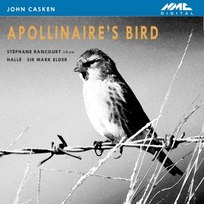
PictureAvailable from NMC -click for details
The shortlist for the 2015 British Composer Awards has been announced.  Congratulations again to Kerry Andrew who has been featured in NATURAL LIGHT.  Kerry is on the shortlist for her liturgical work Salve Regina.  The 36 shortlisted works also include two that were written to commemorate the centenary of World War I and reflect on the powerful  images of nature in wartime that persist and symbolise hope.

John Casken's Apollinaire's Bird is an oboe concerto and a meditation on the brutality of war. It is inspired by Guillaume Apollinaire's poem Un Oiseau Chante, written during the first world war, that describes the birdsong heard above the din of combat and the memories that the song evokes in the minds of the soldiers mired in the trenches below.
​
Papaver, by Dai Fujikura, sets words by regular collaborator Harry Ross.  Taking the universal image of poppies as icons of remembrance, and based on Ross’s realisation that normal life, including the continued presence of poppies, goes on around the war cemeteries of France. 

0 Comments

Nature's Guernica

19/10/2015

0 Comments


Picasso helps locals win momentous victory

Guernica Zilbeti
©Gari Bilbao
The beechwoods of Zilbeti, in the foothills of the Navarran Pyrenees, have seen their fair share of momentous battles.  It was here that Charlemagne's advance was halted by local Basque fighters in 778. Napoleon's France and Spanish forces saw significant action in 1794, and in 1813 Wellington repelled French relief forces after a series of bloody setbacks.  And the peace of the forest could hardly resist the brutality of the 1930s that afflicted all Spain.

Since 2010 another battle has raged, over the future of the forest itself.  Arrayed on one side, a Grand Coalition of the mining company MAGNA and the Government of Navarra.  On the other, the meagre forces of the tiny village of Zilbeti and their supporters in neighbouring areas, local conservation groups and national NGOs such as SEO-BirdLife Spain.

There is much at stake.  The company believe their exisiting magnesite mine is becoming harder to exploit as reserves dwindle.  To gain access to new sources they proposed to fell 54,390 beech trees, including, as local ecologists documented, 17,306 mature ones, some centuries old.  The forest is  home to 20% of Spain's threatened white-backed woodpeckers, as well as European mink and the elusive Pyrenean desman.  Moreover, it is protected under European law.

Villagers and the local organisation Coordinadora Monte Alduide decided to call for reinforcements.  SEO-BirdLife took up the cause and led a legal fight in the Navarran High Court.  But the most audacious manoeuvre came from the local troops themselves
The 1937 bombing by German and Italian forces of Guernica, just 50 miles away, was the most infamous atrocity of the Civil War.  Within months, Picasso's outraged response was touring the world, and was to become the greatest and most famous work of 20th Century art.

A copy now hangs in the United Nations, a tragically impotent talisman to ward off the horrors of war and oppression.

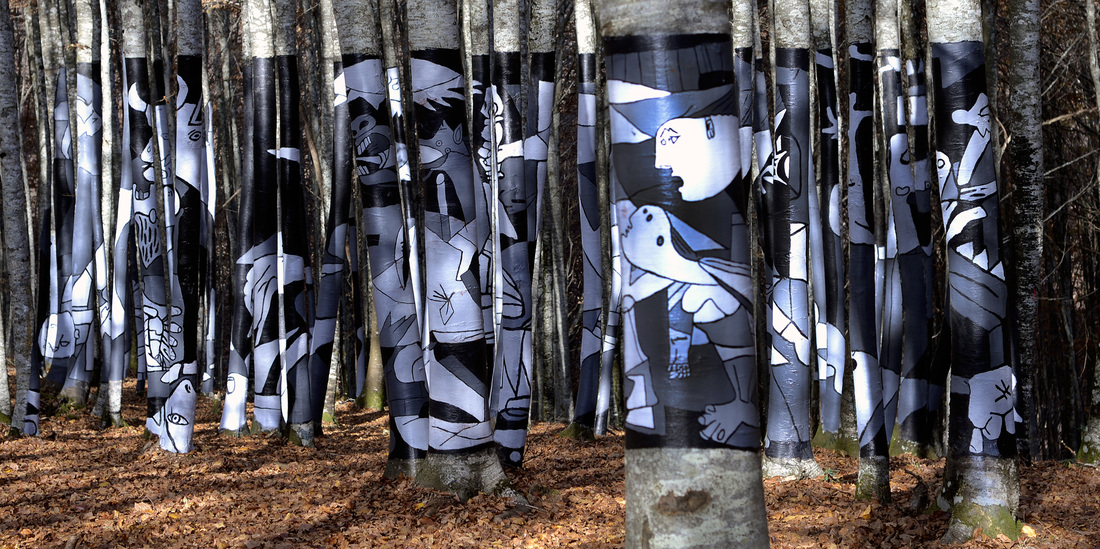
But Picasso's Guernica has at last helped bring a war to an end.  Planning was complex, meticulous and clandestine.  Over six nights, 46 beech trees were chosen and the painting's image projected into the forest in order to establish the exact position of each element.
Picture
©Gari Bilbao
a symbol of oppression and of hope
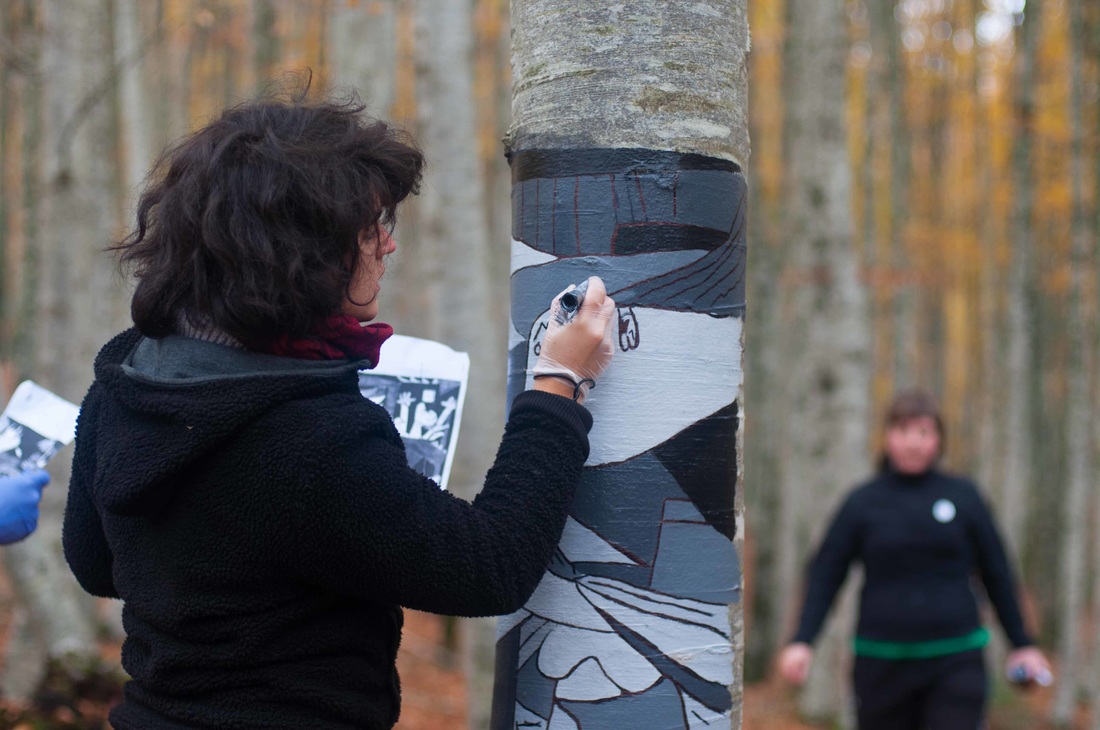
Then, in a single morning, fifty people wielding organic, biodegradable pigments filled in the design.  They created an extraordinary Guernica de Zilbeti some 25 metres wide by 15 high.  It is an incredible study in inverse perspective:  the nearest and farthest trees are separated by 52 metres, yet the final work, if viewed from the specially contructed viewing platform, created a 2-D effect from a vast 3-D space.SEO-BirdLife's Ramón Elosegui said "Guernica is a symbol of the consequences of oppression, but at the same time a symbol of hope."

This week the High Court gave victory to the forest.
Picture
0 Comments

Artists and conservationists respond for nature

14/10/2015

0 Comments

 
In May 2013 twenty-five conservation organisations published a report into the State of Nature in the UK.  It revealed that nature is in trouble - we are losing wildlife at an alarming rate.  On Tuesday, two and a half years on, the same organisations launched  Response for Nature.  Naturalist and TV presenter Steve Backshall was in London alongside UK Environment Minister, Rory Stewart, while similar launches took place in Belfast, Edinburgh and Cardiff. 

While we wait for the four country governments of the UK to respond, there has already been a spontaneous, unprompted reaction from a seemingly unlikely quarter.  Earlier this year  
David Harradine, founder of arts company Fevered Sleep, and I met for a coffee, and he almost casually mentioned that he was working on a new work directly inspired by his reaction to the 2013 report.  

Fevered Sleep invited people from various locations to take a walk with Associate Artist Luke Pell, who recorded the conversations, and turned the words into a poetic landscape.  “It's an attempt to recreate the experience of walking in a real place but in a different form, an on-line form” says David.  The result was An Open Field.

Now one of the twenty-five organisations, the RSPB, and Fevered Sleep have come together.  In its latest podcast, the RSPB invited David and Luke to talk to broadcaster Jane Markham about their own unique and subtly beautiful response for nature.   Click on the button to hear their conversation, and watch the video of Steve Backshall's inspiring presentation.
​

RSPB podcast
0 Comments

Above my head

10/10/2015

0 Comments


Review:  bird sound sculpture at Tate Britain

Picture
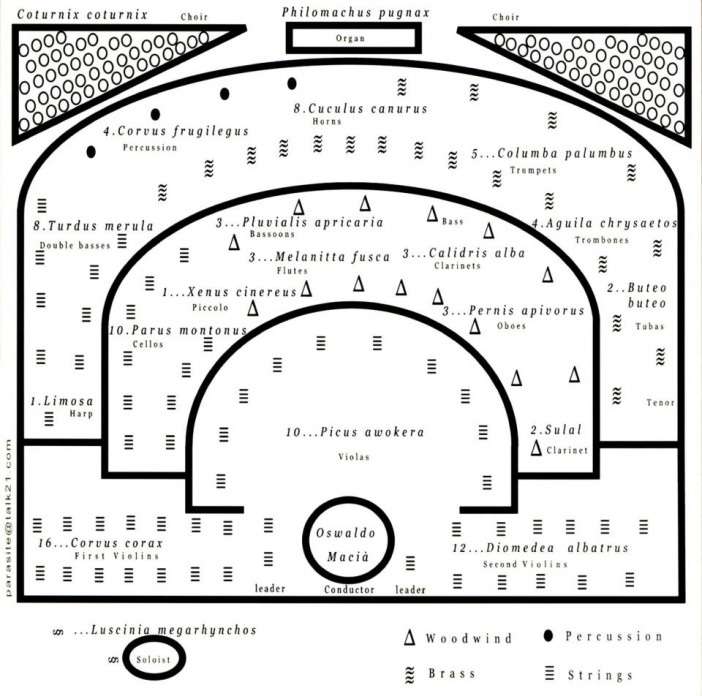
Amost as soon as you enter Tate Britain from Millbank you find yourself within a sound sculpture comprising the songs and calls over over two thousand birds.  Columbian-born, London-based artist Oswaldo Maciá spent five years in the 1990s collecting bird calls from international ornithological archives and audio libraries.  He reworked them into what today we might call a soundscape, scored according to the birds’ pitches.
 
It is an installation that forms part of the Tate’s BP Spotlights, focussing on individual artists or artworks.  There are about a dozen running concurrently, and Maciá’s Something Going on Above My Head (1995-9) is one of the few that have no published close date, so I have no idea for how much longer it is available to experience.
 
It comprises a number of “carefully positioned” speakers that, according to the blurb “fill the space with a mesmerising chorus that the visitor experiences above their head, much in the way that true birdsong is experienced”.  The speakers I saw were spaced regularly in one plane, around the circular ledge that circumscribed the space below a cupola, between the ground floor and first floor.  A hand-out includes the diagram shown here –in which certain birds occupy positions prescribed in the highly standardised layout of a classical orchestra.

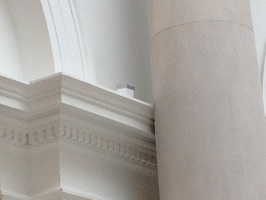
PictureOne of the installation's speakers
​This leads to the first apparent contradiction:  how to create an orchestral layout in a circular space: unless I have misinterpreted the concept.  There is no readily-available information about the previous life of the work, so whether it was originally conceived for a more appropriate space is not clear.  
 
With the birds, you co-inhabit the cupola and its immediate surroundings.  You can hear the sounds above you when at ground level but move to the level above and the sounds are no longer “above your head”.  I could find no information as to how long the piece is before the sequence repeats itself, or indeed whether it comprises a single soundtrack or several overlapping and unequal tracks.  The latter approach could create a piece that repeats every few minutes, days, years, or millennia, but that is not clear, and presumably not important.
 
Unfortunately, nothing about this piece is clear.  Unclarity can, of course, be a virtue in art.  But the programme note makes claims that are difficult to sustain.  The piece is said to illustrate Maciá’s interest in the ambiguity of language.  The title of the work both describes the set-up of the installation and alludes to “daily events that go unnoticed by the majority of people.” The inspiration for the work was a newspaper article that referred in passing to Russian submarines dumping nuclear residues in the Baltic Sea.
 
From there to a carefully orchestrated collage of bird song is quite an abstraction, but fair enough.  But it is not mesmerising.  You either have to listen too carefully to be mesmerised in order to try (and fail, in my case) to detect any sign of orchestration among the overwhelming hubbub of human activity in an appalling acoustic; or you let the sound wash over you, in which case it is as mesmerising as any other background sound in a noisy environment.
 
The orchestral diagram and the possibility of realising it sonically is certainly a nice idea.  The claimed pitch-based link between the species chosen and the instruments they replace is entirely obscure, and the diagram itself contains some oddities such as spelling errors (including the composer’s name!) and incomplete (and one long-obsolete) scientific bird-names. 
 
Piecing together clues, I think the idea is that an artist has taken considerable care to create and present something that you are not supposed to notice, and cannot fully appreciate.  The alternative view is that the Tate bunged some speakers into the least useful of its spaces and Maciá dusted off an old work, neither party caring very much about whether it made any sense.

0 Comments
<<Previous
Forward>>

    Welcome

    to 
    NATURAL LIGHT
    a site devoted to nature, and artists who are 
    inspired by it

    editor Laurence Rose

    Follow us on 
    Facebook and Twitter
    Email us

    RSS Feed

    Tweets by @Naturemusicpoet

    Archives

    October 2018
    September 2018
    May 2018
    January 2018
    December 2017
    November 2017
    October 2017
    August 2017
    June 2017
    May 2017
    April 2017
    October 2016
    July 2016
    June 2016
    April 2016
    January 2016
    December 2015
    November 2015
    October 2015
    September 2015
    August 2015
    July 2015
    June 2015
    May 2015
    April 2015
    March 2015
    February 2015
    January 2015
    December 2014
    November 2014
    October 2014
    September 2014
    August 2014
    July 2014
    June 2014

    Categories

    All
    Australia
    BBC Proms
    Biodiversity
    Birds
    Campaigns
    Cheltenham Festival
    Conversations
    Endangered Species
    Environment
    Fenland
    Festivals
    Flamenco
    Hear And Now
    Iceland
    Landscape
    Literature
    Moth
    Music
    Norfolk Festival Of Nature
    Olivier Messiaen
    Peter Sculthorpe
    Poetry
    Re:Tweet Of The Day
    RSPB
    Sibelius
    Soundscape
    Spain
    Ted Hughes
    The Long Spring
    Uplands
    Wetlands
    Words
    WW1

Powered by Create your own unique website with customizable templates.